
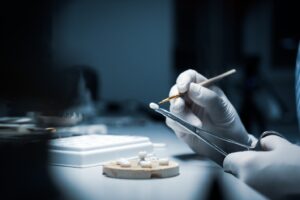
Getting a dental crown is an excellent way to restore a damaged tooth while preserving the appearance and function of your smile. However, if you’re receiving a crown on a visible tooth, you probably don’t want it to stand out from the rest of your teeth. Modern dentistry makes it possible to create crowns that closely resemble natural teeth, but how do dentists determine which shade will blend in best? Color matching is an important part of the crown process, and dentists use several techniques to achieve natural-looking results.
A Dental Shade Guide
Dentists commonly match crown colors by using a dental shade guide. This tool contains small samples of tooth-colored materials in various shades, allowing dentists to compare them with your natural teeth.
Your dentist will hold different samples near the tooth receiving the crown and evaluate which one most closely matches the surrounding teeth. Shade guides typically account for differences in brightness, darkness, and color intensity.
The goal isn’t necessarily to make your crown match the whitest tooth in your mouth. Instead, your dentist wants it to blend naturally with the neighboring teeth.
Considering Natural Tooth Characteristics
Matching a dental crown involves more than simply choosing between white and yellow. Natural teeth have subtle variations in color, translucency, and texture.
For example, the edges of natural teeth may appear slightly more translucent than the areas closer to the gums. Some teeth also have subtle color variations that become more noticeable under different lighting conditions.
Your dentist considers these characteristics when selecting the crown shade. Depending on the material and laboratory techniques used, these details can be incorporated into the final restoration to create a more realistic appearance.
Evaluating Lighting Conditions
Lighting can have a significant impact on how tooth color appears. A shade that looks like a perfect match under bright dental office lighting may look slightly different in natural sunlight.
To reduce the possibility of mismatches, dentists may evaluate tooth color under multiple lighting conditions. They also try to complete shade selection before the teeth become dehydrated during treatment, since dry teeth can temporarily appear lighter than they actually are.
Digital photography may also help dentists and dental laboratories communicate specific color characteristics when creating a custom crown.
Choosing the Right Crown Material
The material used to create your crown can also influence its final appearance. Porcelain and all-ceramic crowns are popular choices for visible teeth because they can closely mimic the translucency and appearance of natural enamel.
Zirconia crowns are another option, offering excellent strength and increasingly natural-looking aesthetics. Your dentist will consider the location of the tooth, your bite, and your cosmetic goals when recommending a material.
If you need a dental crown, discuss your cosmetic expectations during your consultation. Your dentist can explain the available materials and shade-matching process to help you achieve a beautiful, natural-looking result!
About the Author
If you’re looking for a detail-oriented professional for crown treatment, Dr. Alberto Lamberti is a self-proclaimed “perfectionist,” honing his craft here in Boca Raton. A graduate of the esteemed Tufts University School of Dental Medicine, Dr. Lamberti has practiced extensively in prosthodontics for more than 2 decades and counting. Reach his team online or call (561) 338-7535.